"I love you" sounded like inertia
"please" sounds like sacrifice
...
"she could ...pick me out of a crowd just by the smell of my shirt" I knew she meant to say "I love you"
From Family Portrait By Sherman Alexie
from the Lone Ranger and Tonto Fist Fight in Heaven
Friday, November 15, 2013

Thursday, November 14, 2013
Sherman Alexie
"...There are so many rich people who don't share
their shit. They're like spoiled little ten-year-old bullies on the playground.
They hog the monkey bars and the slide and the seesaw. And if you complain even
a little bit, if you try to get just one spin on the merry-go-round, the
bullies beat the shit out of you.”
from Flight by Sherman Alexie
Ok, my mother doesn't read this blog so I will go ahead and say it:
I love Sherman Alexie's work.
I found The Lone Ranger and Tonto Fist Fight in Heaven in the 90s, and enjoyed it so much I kept reading. Mom would never read his work because he uses bad words, possibly for the shock effect, but possibly because that is the way so many people would say that very thing. He has lately been in the public view defending this very kind of language and subject matter in young adult literature, saying it's the world in which many young folks already live.
from Flight by Sherman Alexie
Ok, my mother doesn't read this blog so I will go ahead and say it:
I love Sherman Alexie's work.
I found The Lone Ranger and Tonto Fist Fight in Heaven in the 90s, and enjoyed it so much I kept reading. Mom would never read his work because he uses bad words, possibly for the shock effect, but possibly because that is the way so many people would say that very thing. He has lately been in the public view defending this very kind of language and subject matter in young adult literature, saying it's the world in which many young folks already live.
Wednesday, November 13, 2013

Tuesday, November 12, 2013

"In the most exact sense of the words,
it was the damndest thing you ever saw!"
From "The Cat that Went to Trinity"
by Canadian author Robertson Davies from his book "High Spirits" 1983
a "mock-gothic" short story, and "a kind of gruesome homage to Frankenstein"
quotes from selectedshorts.org where you can hear a delightful retelling
http://ec.libsyn.com/p/a/9/e/a9e9fa4a8890bf9c/PCast_SS201305.mp3?d13a76d516d9dec20c3d276ce028ed5089ab1ce3dae902ea1d01c08430d3c85a5586&c_id=6312798
Monday, November 11, 2013
A Child's Poem for Remembrance Day
fought for us across the sea
brave and unselfish, kind, and true
Keeping Canada free!
I'll wear a poppy on Remembrance Day
To show I'm glad of what they did for me.
God bless our country as a prayer I pray
God keep Canada free!
We learned this song in grade 4, in 1978, funny the things that stick with you.
During all our school years we brought change to school to buy exactly these red poppies the Canadian Legion brought to each class. We wore them during the morning, and played with them all afternoon, and lost them before we got home, usually.
Sunday, November 10, 2013
Pogo Possum on Armistice Day
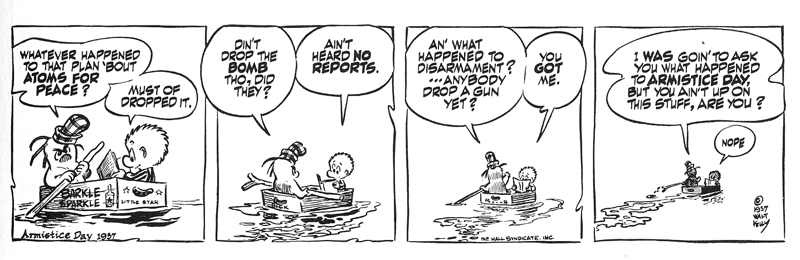
Pogo's remark seems to echo most people's sentiments
I discovered Pogo Possum about 1982, and still read and love the silliness. The political situations still repeat themselves so that Pogo always seem new.
Saturday, November 9, 2013
Flanders Fields, yes, it's all over the web, but this one has a little history with it

Between the crosses row on row,
That mark our place; and in the sky
The larks, still bravely singing, fly
Scarce heard amid the guns below.
We are the Dead. Short days ago
We lived, felt dawn, saw sunset glow,
Loved and were loved, and now we lie
In
Take up our quarrel with the foe:
To you from failing hands we throw
The torch; be yours to hold it high.
If ye break faith with us who die
We shall not sleep, though poppies grow
In Flanders fields.
John Mc Crae was a surgeon during the Boer War and was attached to the 1st Field Artillery Brigade, in the Canadian Army during WWI . The fields referred to are battlefields in Flanders Belgium, and McCrae remarks how quickly poppies grew over the graves of the fallen. The poem was written early in the war while sentiment was still somewhat romantic about "The War to End All Wars" and before fighting forces and civilians became disillusioned as both sides dug 400 miles of trenches.
This poem is popularly believed to have been written in 1915, after he witnessed the death of and presided over the funeral of his friend.
People occasionally interpret it as a pro-war poem although it is often read as an anti-war poem.
Subscribe to:
Posts (Atom)