I saw it again today, this time on a website I really like; the wrong hyphened adjective.
The correct use is old-fashioned
But once recorded wrong in the memory it stays that way in the memory.
I guess.
Make a mental note:
old-fashioned.
Thursday, March 27, 2014

Wednesday, March 26, 2014
Another Hyphenated Adjective

From Max the Mighty by Rodman Philbrick
photo from wikipedia, (though it is of Lafayette, and not a civil war general)
Tuesday, March 25, 2014
Hyphenated Adjectives from MAX THE MIGHTY, and I FUNNY
When you were in grade school, you learned that adjectives were describing words and always preceded the noun. red car
Now, you write more complex adjectives and find that just one isn't sufficient.
A well worn copy of a book with battered cover and curled corners to its pages becomes:
a "dog-eared copy of the book"
the book is not a dog ear, nor just a plain copy, so we hyphenate the adjectives making the imagery more concise and indeed, more visual.
From Max the Mightly by Rodman Philbrick we get:
"chain-link fence"
"quick-talking voice"
"boarded-up windows"
"rolled-up jacket"
We also get triple adjectives like
11-year-old girl"
"mom-and-pop deal"
"no-good, lying creep"
"out-of-control locomotive"
We can play with the order of adjectives like
"she moves slow-footed"
and how about this for conjuring an image:
"filled-to-the-brim dumpster"
I have noticed that recent books seem to use hyphenated adjectives more and more.
In I Funny by James Patterson we find
"the family's road-hogging, gas guzzling, DVD-playing SUV"
"dinner is usually something like tuna noodle casserole made with cream-of-wallpaper soup"
delightful
EXCEPTION you don't need hyphens with LY-adverbs working as adjectives
like previously mentioned article
Grammar girl has an excellent article on hyphens here:
http://www.quickanddirtytips.com/education/grammar/how-to-use-a-hyphen
Monday, March 24, 2014
A Short History of Buffalo Soldiers (not the movie)
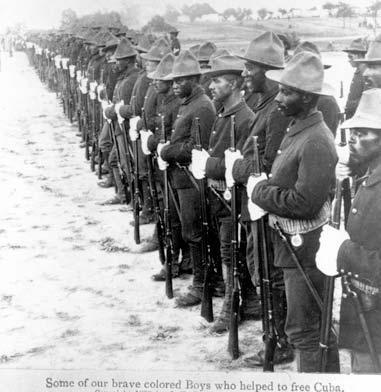
photo from wikipedia
According to the Texas State Historical Society, more than 180,000 African Americans fought in segregated units during the Civil War. After the civil war ended , the peace-time forces retained 6 infantry regiments, (which were later consolidated to 2), and 2 cavalry regiments.
These regiments fought during the Indian Wars, which ended in the 1890s, where the Plains Indians called them Buffalo Soldiers. Stationed in Texas, Oklahoma, Arizona, Nevada, Colorado and the Dakotas during the Indian Wars, they fought renegades, bank robbers, and horse and cattle thieves. They protected stage coaches, payrolls, railroad workers and small towns. 1 These regiments also served in the Spanish American War, including Battles in Cuba. http://www.history.army.mil/documents/spanam/BSSJH/Shbrt-BSSJH.htm , saw service in the Philippines, and Pershing's incursion into Mexico during the Mexican American war.
During World War 1 racial tensions in the US military actually worsened and US white troops fighting in France refused to fight with their Black counterparts. Segregated Black battalions were limited to supporting roles, even though African Americans were willing to fight on the front lines. Although African Americans were awarded honours for valor during the war, they returned to a high level of discrimination and the new NAACP was active in defending the rights of returning veterans with limited success.
With Jim Crow law pervading every aspect of US society, it must have been difficult for African Americans to serve in World War 2. Newspapers in the US proclaimed there was racial harmony as part of war propaganda, yet African Americans who enlisted continued to be segregated.
Black newspapers urged their readers to support the war effort, while still calling on the government to apply Equal Rights to all of its citizens. Many African Americans served faithfully and well, though they were still often relegated to support roles.
The severe shortage of troops in the most desperate fighting of the Battle of the Bulge caused General Eisenhower to send armed African American troops to fight with White troops in the same units. It was an important step in the integration of the US military which occurred 1948, though the last segregated units were not disbanded until 6 years later.
don't confuse this with the movie by that name from 2003 which is an unrelated satire of the military
1) Buffalo Soldiers in Italy: Black Americans in World War 2 by Hondon B Hargrove, McFarland 2003
Also, be sure to listen to Buffalo Soldiers by Bob Marley "stolen from Africa...in the heart of America"
Saturday, March 22, 2014
Langston Hughes was not "denied passage" as such. Why do we recirculate the same phrase?
As I searched information about Langston Hughes for the my recent short posts,
I kept finding the phrased "denied passage on a ship because of his colour" or "denied ship"
This tidbit is posted and reposted as though they are all borrowing from each other.
It doesn't take much searching to find an actual source.
In The Collected Works of Langston Hughes by Langston Hughes he says:
"if I had to work for low wages at dull jobs, I might just as well see the world, so I began to look for work on a ship." he signed to a ship in New York only to find this particular ship was tied up all winter, leaving him lots of time to write. "I was the only Negro in the whole fleet" he wrote. 2
Eventually he travelled to the Western coast of Africa and his travels in those ports make interesting reading. Hughes returned "with a better understanding of the complexities of race and Africa's colonial rule..." according to Langston Hughes edited by Harold Bloom 1
In 1924 Hughes worked on a ship leaving New York for Europe. He jumped ship in Rotterdam, Holland, and went to Paris where it seems he found a love for Jazz. (Remember I mentioned there was another Renaissance among the Black intellectuals in Paris?)
Alain Locke joined him in Paris and the two set off to tour Italy. Hughes' passport and money were stolen on the train, and he had neither money nor papers to book passage. Locke left him a little money and continued on the tour. Langston Hughes thought working on a ship would be the best way to get back to new York, "but none of the ships were hiring Blacks." 1
Hughes lived by his wits (and that's another interesting story) until finding a job on a ship with an all-black crew, finally returning to New York to find he was now well known for his poetry.
All day long at school I tell students this: "don't just look for re-posts of something--go find the original source."
Sources (NOT MLA)
1) Langston Hughes, by Howard Bloom, New York, Broomhall, PA, Chelsea House, Northam, Roundhouse, 2003
2) The Collected Works of Langston Hughes, The Big Sea, vol 13, University of Missouri, September 2002,
Friday, March 21, 2014
Originally named POEM, later renamed YOUTH, by Langston Hughes Also MY PEOPLE

We have tomorrow
Bright before us
Like a flame
Yesterday, a night-gone thing
A sun-down name
And dawn today
Broad arch above the road we came
We march!
published as Poem in 1924, and as Youth in 1932
The night is beautiful,
So the faces of my people.
The stars are beautiful,
So the eyes of my people
Beautiful, also, is the sun.
Beautiful, also, are the souls of my people.
Thursday, March 20, 2014
I, TOO, SING AMERICA with a Little History of Langston Hughes
Langston Hughes lived in Harlem 1928-1930 and was an important voice during the Harlem Renaissance.
When he expressed interest in the principles of social equality of communism, he was investigated by Senator McCarthy's Committee during the communist scare of the 1950s.
(Please remember that McCarthy was known for ignoring due process of law and investigated or intimidated a lot of people)
By the 1960s Hughes was recognized for his literary contributions and was named cultural representative to Europe and Africa for the US State Department, travelling around Europe, China, Japan, Russia and Western Africa.
According Legacy: Treasures of Black History edited by Thomas C Battle, Hughes was robbed of his papers and money after falling asleep on the train from Genoa, Italy to Paris, France. When he tried to get a job on a freighter to return to the US he was refused work, watching white sailors get jobs instead. Discouraged, he wrote I, Too, Sing America on the back of a letter to Alain Locke
Hughes finally returned on a steamer with an all-black crew in exchange for passage with no pay, and his poem was published in 1925


photo from operationhope.org
I am the darker brother.
They send me to eat in the kitchen
When company comes,
But I laugh,
And eat well,
And grow strong.
Tomorrow,
I'll be at the table
When company comes.
Nobody'll dare
Say to me,
"Eat in the kitchen,"
Then.
Besides,
They'll see how beautiful I am
And be ashamed—
I, too, am America
Subscribe to:
Posts (Atom)